
#TLDR: Thousands of players earn college spots every year — but they all do the same things right: start early, build a quality highlight video and player profile, and reach out to coaches directly. The ones who get recruited don’t wait to be found. This guide walks you through every step.
Table of Contents
- How College Soccer Recruiting Works
- NCAA, NAIA, and NJCAA: Which Division Is Right for You?
- The Year-by-Year Recruiting Timeline
- What College Soccer Coaches Look For
- How to Get a College Coach to Notice You
- The First Email to a Coach: What to Say
- Common Recruiting Mistakes to Avoid
- FAQ
How College Soccer Recruiting Works
College soccer recruiting is the process by which college programs identify, evaluate, and sign players. Coaches are the decision-makers — they set their roster needs, watch players at tournaments and showcases, review highlight videos and player profiles, and ultimately decide who gets a scholarship offer or walk-on spot.
The process looks different depending on the division level, but the core steps are consistent:
- A player enters a coach’s radar — through a showcase, a highlight video, a direct email, or a referral from a club coach
- The coach evaluates the player via video and live scouting
- Communication begins — emails, calls, campus visits
- If there is a strong fit, the coach extends an offer or expresses serious interest
- The player commits verbally, then signs a National Letter of Intent (NLI) or equivalent during a designated signing period
The keyword in step 1 is “enters a coach’s radar.” That does not happen by itself. Players who get recruited are the ones who make themselves visible and easy to evaluate. (NCSA)
NCAA, NAIA, and NJCAA: Which Division Is Right for You?
Before you start emailing coaches, understand which level fits you athletically and academically. Aiming only at D1 programs when D2 or NAIA is a better fit costs time and kills momentum.
NCAA Division I
The most competitive level. Full athletic scholarships are available, but spots are extremely limited. Coaches identify targets as early as freshman or sophomore year. Rosters often fill up 1–2 years before a player’s graduating class. If D1 is your goal, you need to start building your profile and reaching out no later than sophomore year.
NCAA Division II
Strong soccer with a mix of athletic and academic scholarship funding. Recruiting timelines are slightly more relaxed than D1, with many offers coming junior year. D2 programs are often underrated — the level of play is high and the financial packages can be competitive. (Select Generation)
NCAA Division III
No athletic scholarships, but strong academic financial aid. D3 programs recruit based on fit and interest. The timeline is the most flexible — some programs finalize rosters as late as the fall of senior year. For players whose priority is academics and who want to keep playing at a high level, D3 is a serious option.
NAIA
Often overlooked, NAIA programs offer athletic scholarships and a high level of competition. Recruiting is more flexible than the NCAA and extends through senior year. International players also find strong pathways through NAIA.
NJCAA (Junior College)
Two-year programs that give players a chance to develop, get exposure, and transfer into a four-year program. NJCAA schools recruit late and often fill spots close to the season. For players who start the process late or need time to develop, JUCO is a genuine pathway — not a fallback.
The Year-by-Year Recruiting Timeline
Freshman Year: Build the Foundation
No college coach will contact you as a freshman, but the decisions you make now matter. Focus on:
- Building a strong GPA from day one — coaches check grades at every level
- Developing game film you can use later
- Researching what the different divisions look and feel like
- Attending local ID camps to see where your level sits
Sophomore Year: Get Visible
This is when the process starts in earnest. Coaches can receive contact from players (though they cannot call back yet). Steps to take:
- Build a basic player profile with your position, grad year, academic info, and a short highlight video
- Attend ID camps at programs you’re interested in
- Send your first emails to coaches with your profile link and upcoming schedule
- Start keeping a spreadsheet of programs you’ve contacted and their responses
Junior Year: Active Recruiting Begins
This is the most critical year. Coaches can now respond to your messages, call you, and invite you on visits. D1 programs are close to full for your class — act now if that’s your goal. Steps to take:
- Send updated highlight videos and academic transcripts
- Register with the NCAA Eligibility Center
- Follow up consistently with programs that haven’t responded
- Go on unofficial visits to your top programs
- Target a realistic range of schools across divisions
Senior Year: Decisions and Final Steps
By senior year, you should have serious conversations with multiple programs. If you haven’t committed yet:
- Keep reaching out — NAIA and D2 programs often have spots for the senior year
- Make sure your profile and highlight video are fully updated
- Confirm official visit invitations and attend them
- Stay on top of FAFSA and academic scholarship deadlines alongside athletic offers
- Do not limit yourself to programs that reached out to you — coaches respond to players who demonstrate genuine interest
What College Soccer Coaches Look For
Coaches evaluate recruits on four dimensions — in this order:
1. Technical and Tactical Ability
Ball control, passing accuracy, decision-making, and positioning. Coaches watch game film to evaluate how you play within a system, not just how you perform in isolation. A player who understands the game is more valuable than a player with raw skills who plays selfishly.
2. Physical Profile
Speed, endurance, strength, and size are relative to the position. Not every program needs the same physical profile — a technical D2 program may value soccer IQ over pace, while a physical D1 program may weigh athleticism more heavily.
3. Academic Performance
GPA and eligibility are non-negotiable. A player who doesn’t meet eligibility requirements cannot play, regardless of talent. Coaches at scholarship programs also want players who will stay eligible for four years. A strong GPA also opens the door to academic aid on top of athletic scholarships. (Select Generation)
4. Character and Coachability
Coaches recruit people, not just players. They want to know how you respond to criticism, how you communicate with teammates, and whether you show up when things are hard. These signals come through in your highlight video, your emails, your visits, and your coach references.
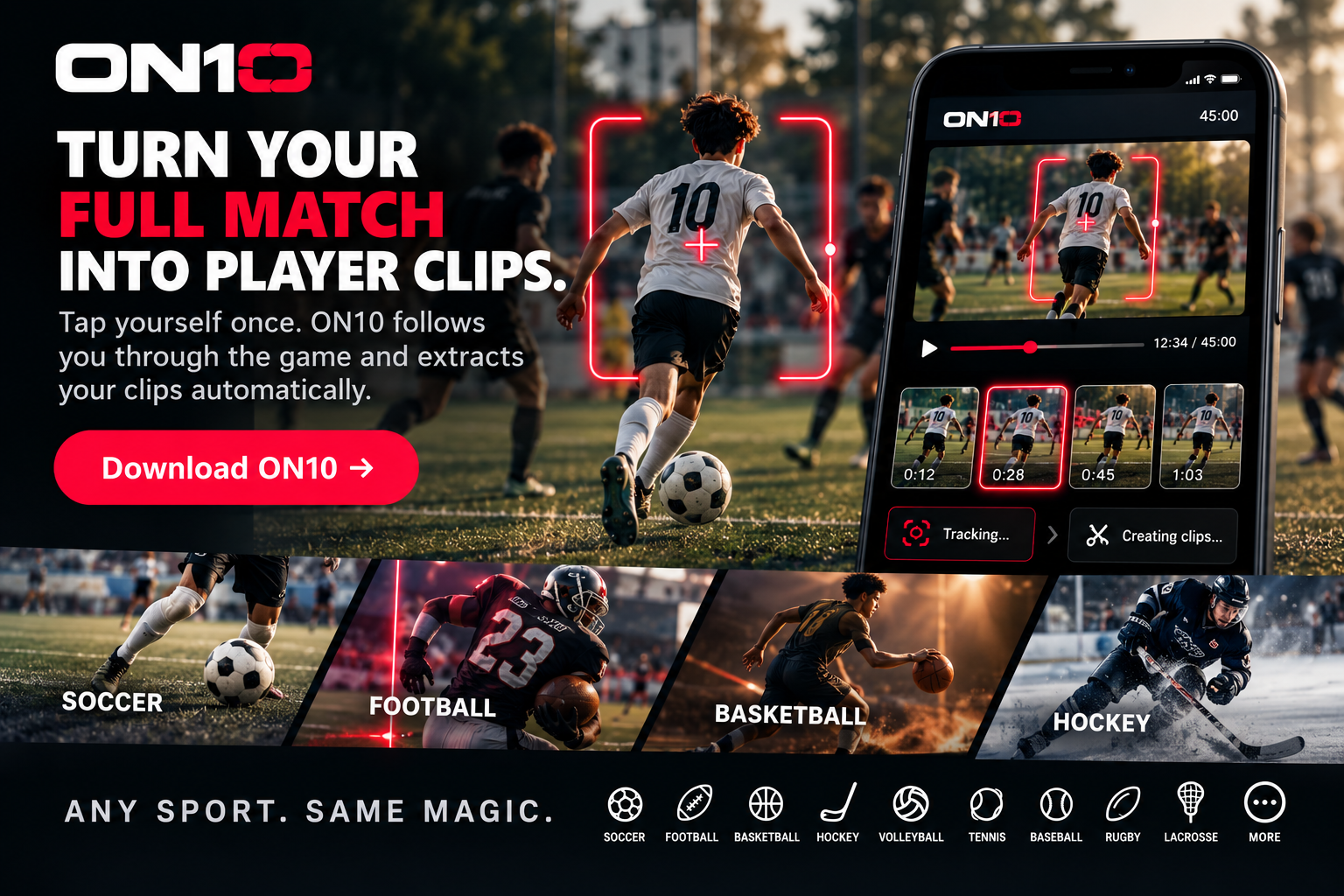
Talnets is becoming ON10. Meet the new way to get your clips.

How to Get a College Coach to Notice You
Waiting to be discovered is the most common and most costly mistake in college soccer recruiting. Coaches are busy. They are not sitting in their offices searching databases for unknown players. Here is how to actually get on their radar:
Build a Professional Player Profile
A profile is the single link a coach clicks to learn everything about you. It should include your highlight video, verified stats, position, academic information, and contact details — all in one place. A clean, professional profile signals that you take the process seriously. A disorganized or incomplete one signals the opposite.
Talnets generates an AI-powered player profile from your game footage — combining verified stats, highlight clips, and an AI-written player analysis into one shareable link. A coach opens one link and sees everything. No back and forth, no missing information.
Create a Strong Highlight Video
Your video is your audition. Keep it to 2–4 minutes, lead with your 5 best plays, include your contact details on the first frame, and show a variety of skills. Coaches watch on mute and decide whether to keep watching within the first 10–15 seconds.
Email Coaches Directly
Do not wait for coaches to find you. Research programs that fit your athletic and academic profile, then send a short, personal email with your video link and why you’re interested in that specific program. Coaches respond to players who do their homework — generic mass emails stand out for the wrong reasons.
Attend Showcases and ID Camps
Live scouting still drives D1 recruiting. Events like ECNL Nationals, US Club Soccer showcases, and regional tournaments are where coaches invest their scouting time. Attending the right events puts you in front of multiple coaches at once.
Follow Up
One email is not enough. If you haven’t heard back after two weeks, follow up with an update — a new tournament schedule, an updated highlight clip, your latest grades. Coaches are not ignoring you out of disinterest; they are managing hundreds of emails at once.
The First Email to a Coach: What to Say
Keep it short. Three to four sentences is enough. Here is a framework:
“Coach [Name], my name is [Your Name], a [position] from [Club Team] in the Class of [Year]. I am very interested in [School Name]’s soccer program and believe my style fits what you’re building. My profile and highlight video are here: [link]. I would love the chance to connect — my next tournament is [date/location].”
What to include:
- Your name, position, graduating class, and club team
- One specific reason you’re interested in that program
- A link to your player profile or highlight video
- Your next game or tournament date
What to leave out:
- Generic compliments (“I’ve always dreamed of playing at your school”)
- Long career summaries
- Attachments (links only — coaches will not open attachments from unknown players)
Common Recruiting Mistakes to Avoid
Starting too late. D1 programs often have verbal commitments in place a year or two before signing day. If you start emailing coaches senior year for D1 spots, most rosters are already set.
Only targeting D1 programs. Less than 1.1% of high school players make a D1 roster. D2, NAIA, and D3 programs offer strong soccer, real scholarships, and better playing time — especially early in a career.
Not following up. Coaches receive hundreds of emails. A single message rarely gets a response. Consistent, respectful follow-up shows persistence and genuine interest.
Ignoring academics. A great player with a low GPA becomes a problem for a coach who needs athletes to stay eligible. Academic performance is a recruiting filter, not an afterthought.
Using a generic highlight video. A one-size-fits-all reel that starts with a long intro, runs for 8 minutes, and shows only goals tells a coach you don’t understand recruiting. See our complete guide to soccer highlight videos for exactly what to include.
Waiting to be found on a platform. Paying for a recruiting service and then waiting for coaches to search for you is a passive strategy. Coaches are not browsing databases — they are responding to players who reach out. Use platforms as a professional-looking profile, not a passive listing.
FAQ
How does college soccer recruiting work?
Coaches identify players through showcases, highlight videos, player profiles, and direct emails from athletes. Players who reach out proactively and make themselves easy to evaluate get recruited. Waiting to be found rarely works.
When should I start the college soccer recruiting process?
Freshman or sophomore year for players targeting D1. Junior year is still workable for D2 and NAIA. Even seniors can find opportunities at NAIA, D3, and NJCAA programs. The earlier you start, the more options you have.
What GPA do you need for college soccer recruiting?
There is no universal minimum, but NCAA D1 and D2 programs require players to meet NCAA Eligibility Center standards. A GPA above 3.0 opens most doors. Coaches also want players who will stay academically eligible for four years.
How many college soccer scholarships are available?
NCAA D1 men’s soccer programs offer up to 9.9 scholarships per team, split among the roster. D1 women’s programs offer up to 14. D2 offers fewer, and D3 offers none. NAIA programs vary. Most scholarships are partial, not full rides. (NCSA)
Do college coaches look at highlight videos?
Yes — highlight videos are often the first evaluation tool a coach uses before deciding whether to watch a player live or follow up. A strong 2–4 minute reel with clear contact information and variety of skills is essential at every division level.
Can international players play college soccer in the US?
Yes. International players are eligible to play NCAA, NAIA, and NJCAA soccer. The process requires meeting eligibility requirements and working through the student visa process alongside athletic recruitment. Many programs actively recruit international players.
What is the difference between a verbal commitment and signing day?
A verbal commitment is a non-binding agreement between a player and a program. It can happen at any point in the recruiting process. Signing day is when a player signs a National Letter of Intent (NLI), making the commitment official and binding. NLI signing periods are set by the NCAA calendar.
Talnets is becoming ON10.
Meet the new way to get your clips.